An ALCOA+ audit trail for LLM calls
The smallest honest example of turning AI telemetry into 21 CFR Part 11 validation evidence — a tamper-evident, hash-chained audit trail for every model interaction.
Feel free to download the python code to play around with this yourself. It’s a small set of python files with a minimal streamlit app to help visualize the topic.
When a regulated GenAI system meets an inspector, three questions decide whether a model interaction is a record or just a log line:
- Who did this, and on whose behalf?
- What exactly happened — prompt, model, parameters, output?
- Prove it hasn’t changed since.
This example shows which concrete field or control satisfies each ALCOA+ attribute — with the integrity claim made cryptographic (a hash chain).
Why do we care? - GenAI in pharma quality & manufacturing
For common use cases like an LLM that drafts or reviews a batch record, a deviation, a CAPA, or an SOP — the model’s output now feeds a record a QA lead signs off on, and an inspector can demand its full lineage years later. “The model summarized this deviation” is not enough: you have to prove who invoked it, what prompt and model version ran, and that the stored interaction hasn’t been edited since.
That is the same shape wherever an LLM sits on the path to a regulated decision — pharmacovigilance, clinical study report drafting, regulatory-submission QC.
The moment an AI output becomes part of a record with a retention obligation and a named human owner, a flat log file stops being evidence. This is an easily digestible example of the control that makes it evidence again.
Why this matters to you as a GenAI system dev or System Owner?
A complete audit trail turns an inspection finding into a non-event. The cost of not having one is a data-integrity 483 plus a full remediation cycle.
The ALCOA+ to field mapping (the point of this post)
| ALCOA+ | For an LLM call, means… | Concrete field / control |
|---|---|---|
| Attributable | who triggered it, on whose behalf | actor.principal + actor.agent + actor.auth — never anonymous |
| Legible | permanently human- & machine-readable | structured JSON, stable key names |
| Contemporaneous | recorded at the moment | timestamp_utc, set server-side at the call boundary |
| Original | first verbatim capture preserved | interaction.request/response verbatim, committed into record_hash |
| Accurate | matches what actually ran | exact model, params (temp 0), prompt_sha256, usage |
| Complete | nothing silently dropped | outcome.status; errors, retries, human overrides recorded too |
| Consistent | same shape & order | schema_version + monotonic seq + fail-closed validation |
| Enduring | durable & tamper-evident | append-only store + hash chain (prev_hash -> record_hash) |
| Available | retrievable for retention | retention block + export + reviewer view |
The integrity rule, in one line
In our little example project provided - Edit, insert, reorder, or delete any record after the fact and verify.py recomputes the hashes,
finds the break, and names the exact seq. That is the cryptographic proof of Original and
Enduring that a flat log file can never give you.
record_hash = sha256( canonical_json( record_without_record_hash ) )
prev_hash[0] = GENESIS;   prev_hash[n] = record_hash[n-1]
See it run
The whole thing is standard-library Python with no API keys — a deterministic mock provider stands in for the model, so it’s clone-and-run. One command builds a trail, prints it, verifies it, and then tampers with it:
python demo.pyThree LLM calls just happened, and each became one record:
seq 0— a normal success.seq 1— a call that failed upstream, and notice it was still recorded and then re-raised. A failed call must never be a missing record — that is ALCOA+ Complete.seq 2— a success that a human reviewer overrode: the model said one thing, a QA lead corrected it, and that correction is itself an auditable event.
Each record’s prev is the previous record’s hash. Record 0’s prev is all zeros — the genesis
link.
One record, the mapping made concrete
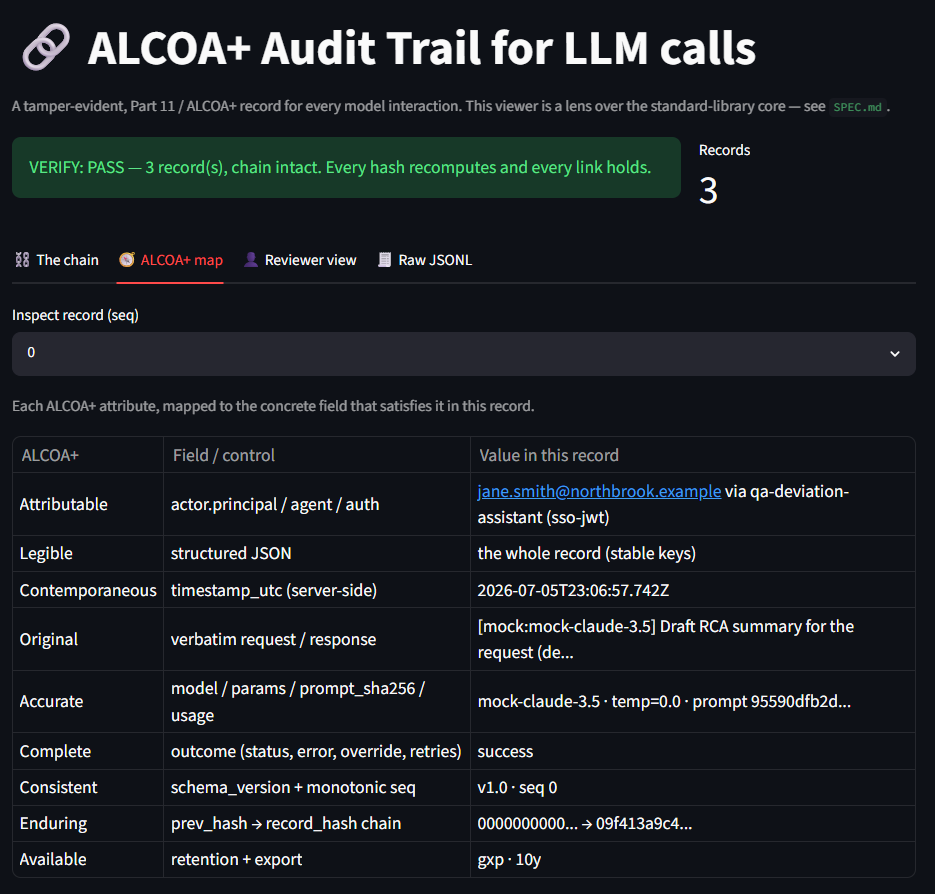
Go ahead and pull the first record out of the trail and the abstract table above turns into a single JSON object:
python -c "import json; print(json.dumps(json.loads(open('audit-trail.jsonl').readline()), indent=2))"Every ALCOA+ attribute is a concrete field: Attributable → actor (who, which agent, how they
authenticated — never anonymous); Contemporaneous → timestamp_utc, set server-side at the call
boundary, not whatever the client claims; Original / Accurate → the verbatim request and
response, the exact model, temperature 0, a hash of the prompt, token usage; Enduring →
prev_hash and record_hash, the chain.
A validator reads this and can answer “who did what, when, with which model” without trusting me.
Log Tamper detection
Anyone can keep a JSON log. The question an inspector actually asks is prove it wasn’t changed. The demo copies the trail, edits record 0’s response text — exactly what someone “fixing” a log file would do — without recomputing its hash, then re-verifies both. The exit codes are real, which is what makes this a CI gate:
python verify.py audit-trail.jsonl          # PASS -> exit 0
python verify.py audit-trail.tampered.jsonl # FAIL -> exit 1, names seq 0, record_hash mismatch
The interactive viewer makes it visual: in the ⛓️ The chain tab, tamper with a record and watch that block and everything downstream turn red as the banner flips to FAIL.
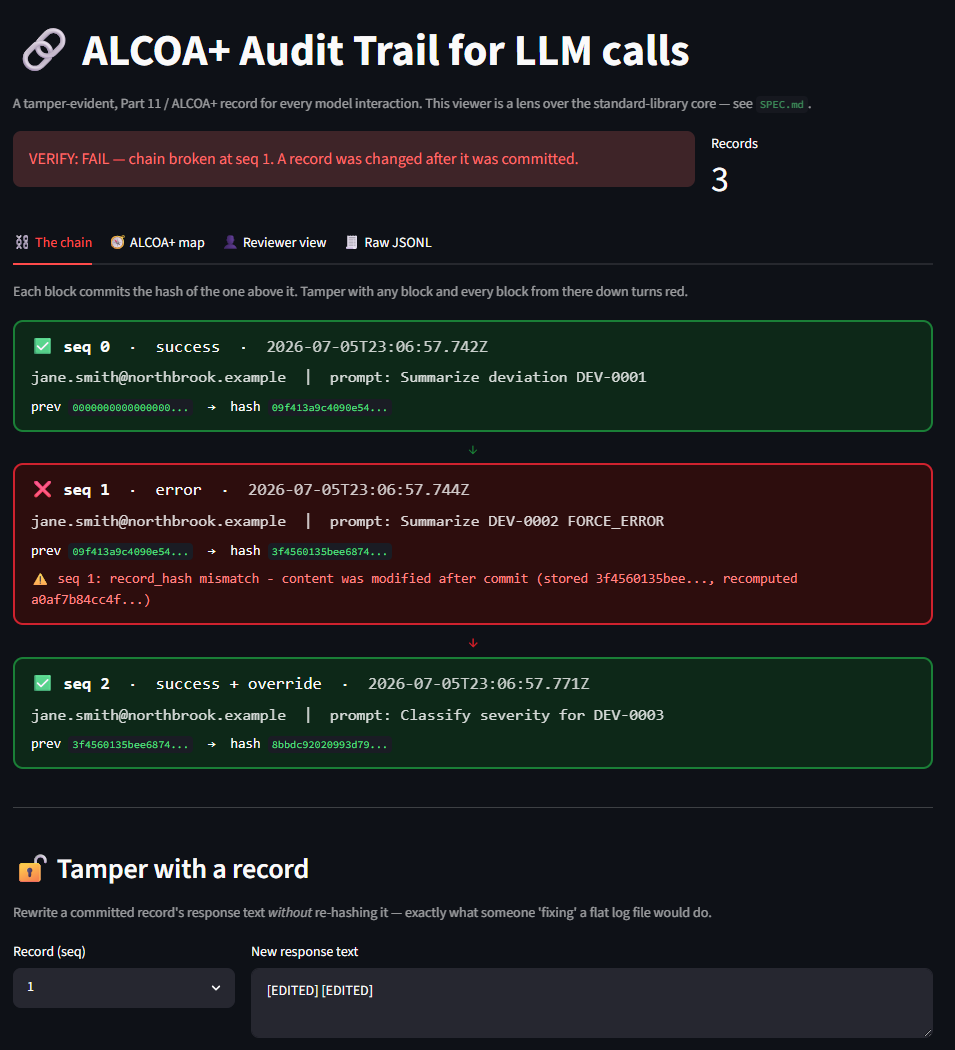
Because each record commits the hash of the one before it, you can’t quietly change history — editing one record breaks every link after it. That is the cryptographic proof of Original and Enduring a flat log can never give you.
Why this is validation evidence, not just security
Security people see a tamper-evident log. An ITQ team sees something more specific:
- the exit code drops straight into a CI gate — a build can fail if the audit trail’s integrity is broken. That is an OQ-style control.
- the reviewer view (
python demo.py --review) is the human-readable export an auditor reads — ALCOA+ Available. - the schema fails closed — a malformed record is rejected, never stored — so you can’t end up with an “Accurate/Complete” trail full of garbage.
The same artifact is a security control and a piece of validation evidence. That overlap is the whole position. And the test names are the spec: tampered content is detected, a deleted record breaks the chain, the schema fails closed, the hash is canonical-order-independent.
pytest -qWhat this is — and isn’t
- It is: the minimal, vendor-neutral teaching version. The artifact is understanding.
- It is: A small streamlit app created to illustrate the concepts covered
- It isn’t: a product. No DB server, no cloud, no auth system, no scale.